
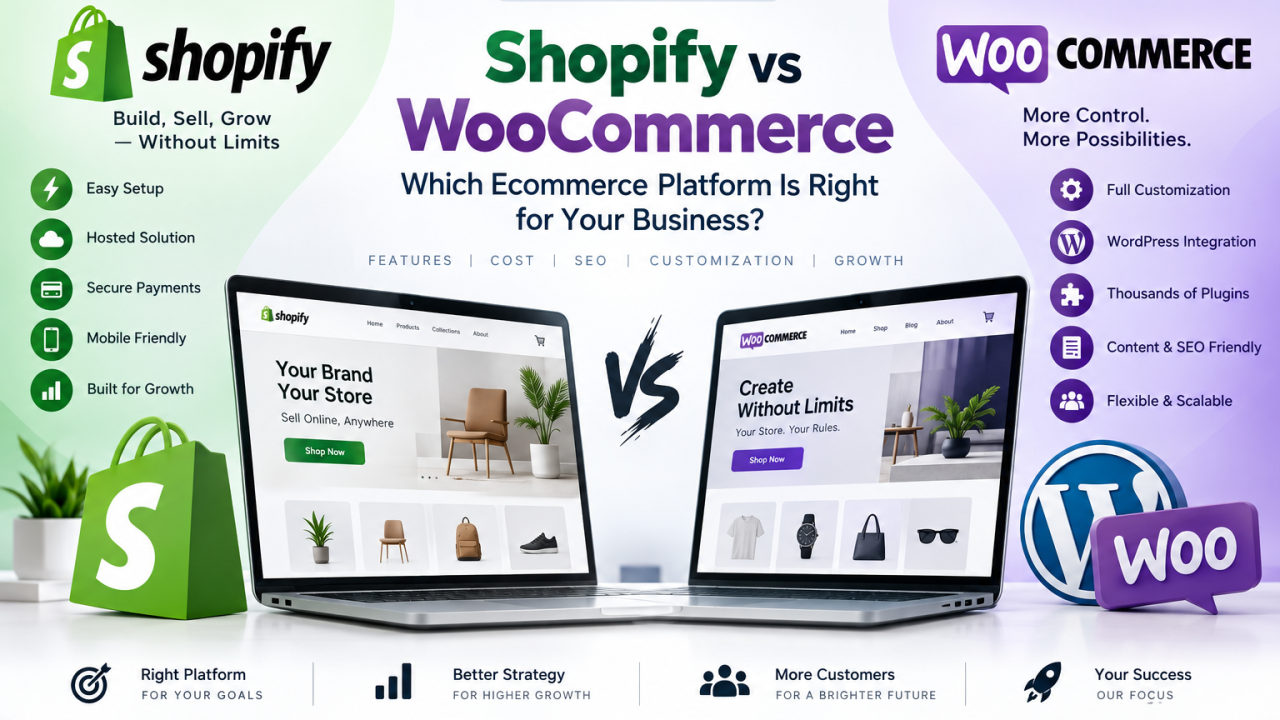
Shopify vs WooCommerce: Which Ecommerce Platform Is Right for Your Business?
Shopify vs WooCommerce: Choosing the Right Ecommerce Platform
Compare WooCommerce & Shopify to see which platform is best for your business. We cover pricing & fees, flexibility & scalability, and more. : Starting an online store is easier than ever, but choosing the right ecommerce platform can make a big difference to your business growth. Two of the most popular options are Shopify and WooCommerce.
Both platforms can help you build a professional online store, accept payments, manage products, and sell to customers online. However, they work differently and are designed for different business needs. In this guide, we will compare Shopify vs WooCommerce their features, benefits, costs, SEO capabilities, customization options, and ease of use—so you can choose the right platform for your ecommerce business.
What Is Shopify?
Shopify is a hosted ecommerce platform that allows businesses to create and manage an online store without handling complicated hosting or server management. With Shopify, you can manage products, orders, payments, customers, shipping, marketing, and analytics from one unified dashboard.
Why Choose Shopify?
Shopify is a good choice for businesses that want to launch an ecommerce store quickly and focus more on selling than technical management. Key benefits include:
- Easy store setup and user-friendly interface
- Professional ecommerce themes
- Secure, fully managed hosting
- Integrated payment gateway options
- Streamlined inventory and order management
- Mobile-friendly store layouts
- Extensive app integrations
- Built-in marketing and analytics tools
- Multichannel selling capabilities
Best suited for: Startups, growing brands, D2C businesses, and companies that want a scalable ecommerce solution without technical overhead.
What Is WooCommerce?
WooCommerce is an open-source ecommerce plugin for WordPress. It converts a standard WordPress website into a fully functional online store. Unlike Shopify, WooCommerce gives you full control over your website hosting, underlying code, plugins, and overall store structure.
Why Choose WooCommerce?
WooCommerce is a strong option for businesses that want absolute flexibility and extensive customization. Core benefits include:
- Complete website ownership and control
- Flexible, open-source customization
- Large WordPress plugin ecosystem
- Thousands of themes and design extensions
- Strong content marketing and blogging integration
- Flexible, customizable payment gateways
- Custom product parameters and checkout flows
- Advanced SEO customization possibilities
- Ideal for content-heavy ecommerce websites
Best suited for: Businesses that already use WordPress, or those requiring a highly customized ecommerce architecture.
Shopify vs WooCommerce: Feature Comparison
Everything you need to know about WooCommerce vs Shopify, simplifying your understanding of both and help you decide for your online store. There is no single answer to which platform is better. The right choice depends on your business size, technical resources, budget, customization requirements, marketing strategy, and long-term goals.
| Feature | Shopify | WooCommerce |
|---|---|---|
| Ease of Use | Very Easy (Plug-and-play setup) | Moderate (Requires WordPress knowledge) |
| Hosting | Included (Managed cloud infrastructure) | Managed Separately (Self-hosted) |
| Customization | High (Via themes & liquid templates) | Very High (Complete code & plugin access) |
| Technical Control | Limited compared to open-source | Extensive full-stack control |
| SEO Flexibility | Good (Out-of-the-box SEO tools) | Excellent (Advanced plugins like Yoast/RankMath) |
| Content Marketing | Good (Built-in blog module) | Excellent (Native WordPress blogging power) |
| Store Setup Speed | Faster launch times | Requires more setup & configuration |
| Scalability | Excellent (Automatic server scaling) | Excellent (Requires optimized hosting setup) |
| Maintenance | Easier (Handled by platform) | More Hands-On (Updates & security checks) |
| Best For | Fast, hassle-free ecommerce setup | Highly flexible & customized stores |
SEO Performance: Shopify vs WooCommerce
Is Shopify Good for SEO?
Yes. Shopify provides many important built-in SEO features, including editable page titles, meta descriptions, customizable URLs, image optimization options, automated redirects, and structured canonical tags. However, organic search success depends on more than just the underlying platform.
A comprehensive Shopify SEO strategy should include:
- Targeted keyword research
- Search-friendly product descriptions
- Category page optimization
- Strategic internal linking
- Image compression and Alt text placement
- Technical SEO audits
- Page speed optimization
- Quality backlink acquisition
- Structured schema markup integration
Is WooCommerce Good for SEO?
Yes. WooCommerce can be highly effective for SEO because it operates on WordPress, offering granular control over website content, site architecture, and code. Businesses can optimize:
- Granular product page structures
- Rich blog content and custom taxonomy
- Category and archive pages
- URL permalink structures
- Meta data and Open Graph tags
- Custom schema markup
- High-converting landing pages
Next-Gen Optimization: AEO and GEO for Ecommerce
Shopify or WooCommerce: Which Is Better for AEO?
Answer Engine Optimization (AEO) focuses on creating content that directly answers specific questions asked on search engines and AI-powered response systems. For ecommerce businesses, addressing core AEO queries builds domain authority:
- What is Shopify?
- What is WooCommerce?
- Is Shopify better than WooCommerce for startups?
- Which ecommerce platform is best for small businesses?
- Is WooCommerce good for search engine optimization?
- How much does it cost to build an ecommerce website?
Both platforms support AEO equally well, provided your store integrates clear content structures and JSON-LD schema markup that AI answer engines can parse easily.
How Does GEO Help Ecommerce Websites?
Generative Engine Optimization (GEO) focuses on optimizing website content so that it gets understood, cited, and recommended by modern AI search models. To create GEO-friendly store content:
- Answer product and transactional questions directly.
- Use natural, conversational language patterns.
- Provide deep context and verifiable product details.
- Organize information using clear, descriptive heading tags (
<h2>,<h3>). - Include real-world use cases and comparisons.
- Avoid unnecessary keyword stuffing.
- Demonstrate high Experience, Expertise, Authoritativeness, and Trustworthiness (E-E-A-T).
Which Ecommerce Platform Should You Choose?
Shopify vs WooCommerce for Small Businesses
For a small business owner who wants a simple and quick ecommerce setup, Shopify is easier to manage day-to-day. WooCommerce is the better choice if the business demands total control over design, site structure, and advanced functionality without monthly app fees.
Shopify vs WooCommerce for Growing Businesses
Both platforms scale effectively to handle high transaction volumes. Shopify offers a managed ecosystem that eliminates server administration tasks. Shopify vs WooCommerce offers unlimited customization, though growing brands must invest in enterprise managed hosting, robust security protocols, and dedicated technical maintenance.
Quick Selection Checklist:
Choose Shopify if you want:
- A faster store launch
- Easier technical management
- Fully managed hosting and SSL
- A simple, unified admin dashboard
- Reliable, hands-free scalability
Choose WooCommerce if you want:
- Greater design and code customization
- Complete ownership of your store infrastructure
- Native WordPress content marketing capabilities
- Flexible custom checkout functionality
- Zero platform transaction fees (beyond payment processor fees)
Frequently Asked Questions
1. Is Shopify easier to use than WooCommerce?
Yes, Shopify is generally easier for beginners because it is a fully managed platform. Hosting, security, and payment integrations are configured out of the box, whereas WooCommerce requires manual setup on WordPress.
2. Which platform is cheaper, Shopify or WooCommerce?
WooCommerce software is free, but you must pay for hosting, domain registration, security certificates, and paid plugins. Shopify charges a fixed monthly subscription fee that includes hosting, security, and support, making costs more predictable.
3. Can I migrate my store from WooCommerce to Shopify (or vice versa)?
Yes, you can migrate store data—including product catalogs, customer databases, and order histories—between platforms using dedicated migration plugins, CSV imports, or professional developer services.